

If you’re planning to enter the forex brokerage business, you’ll quickly run into a big decision:
Should you choose a White Label solution or go for a Turnkey Forex Solution?
Both models are popular, both can work well, and both are often marketed as the “best choice.” But in reality, the better option depends on your business goals, budget, control preferences, and growth strategy.
Let’s break this down in plain, practical language.
First, What’s the Difference?
At a glance, White Label and Turnkey solutions may look similar because both allow brokers to launch faster without building everything from scratch. But the structure behind them is quite different.
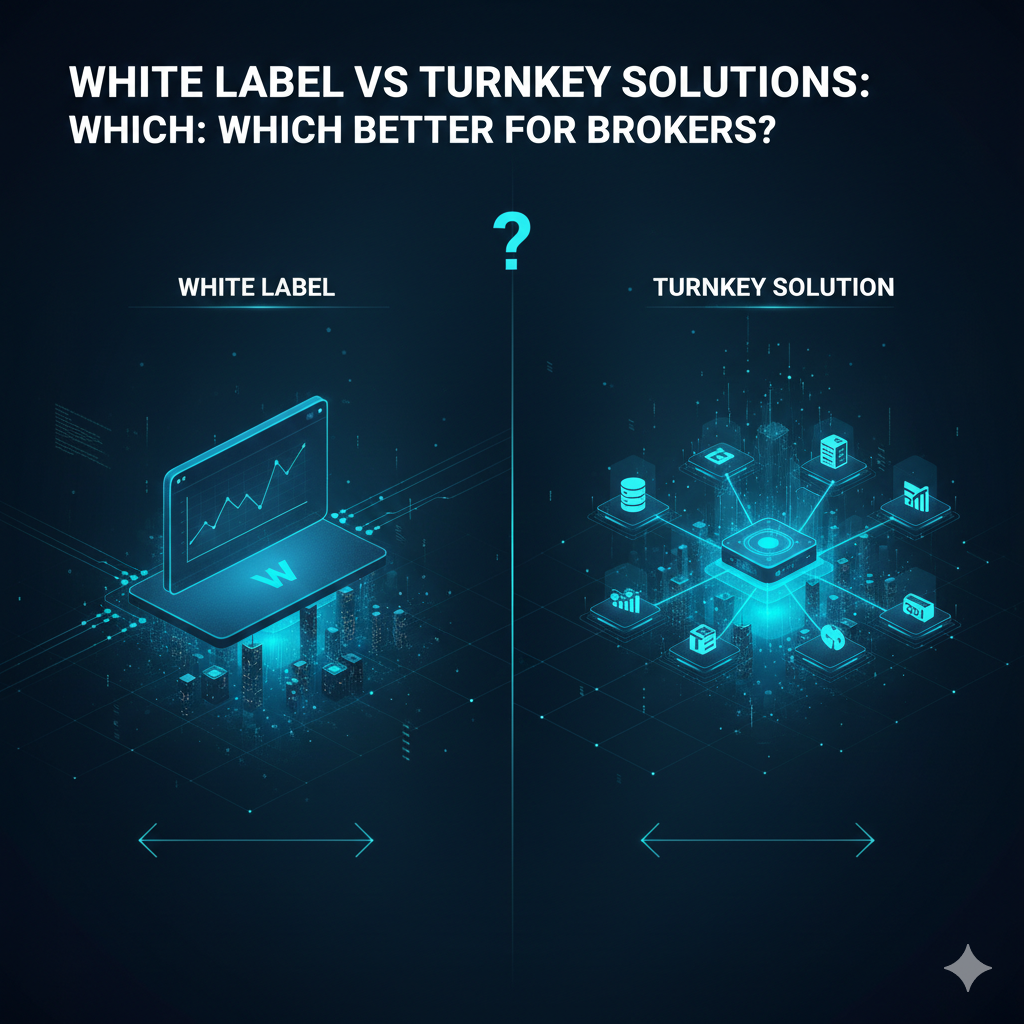
A White Label solution typically means you operate under the infrastructure of an existing broker or technology provider. You get your own branding and client interface, but the core systems — like liquidity, servers, and sometimes compliance coverage — are controlled by the primary provider.
A Turnkey Forex Solution, on the other hand, is closer to a full brokerage setup. It usually includes trading platform integration, CRM, back office, payment systems, liquidity connections, and operational tools, all delivered as a ready-to-launch package. The broker operates independently with greater ownership and flexibility.
Why Many New Brokers Start with White Label
White Label setups are often seen as the easier entry point.
They require lower upfront investment and allow brokers to launch quickly because most of the heavy infrastructure is already in place. For startups testing a business model or entering the market with limited capital, this can be attractive.
Another advantage is reduced technical responsibility. Since the primary provider manages the backend systems, brokers can focus more on marketing, client acquisition, and sales.
However, convenience comes with trade-offs.
White Label brokers typically have limited control over pricing structures, liquidity conditions, platform configurations, and sometimes even risk management policies. Scaling can also become restrictive depending on the provider’s framework.
Why Turnkey Forex Solutions Appeal to Growth-Focused Brokers
Turnkey solutions are designed for brokers who want more independence.
Instead of operating under another broker’s umbrella, you receive a complete brokerage ecosystem — trading platform, CRM, back office, payment gateway integrations, and liquidity connectivity — configured for your brand.
This model offers greater control over:
• Business operations
• Liquidity relationships
• Payment flows
• Risk management settings
• Client experience
Turnkey solutions are often preferred by brokers planning long-term expansion, unique product offerings, or multi-asset growth.
Of course, more control usually means higher initial investment and greater operational responsibility. But many brokers see this as a strategic investment rather than a cost.
Comparing White Label vs Turnkey Forex Solutions
Control & Independence
White Label brokers operate within the provider’s environment. Turnkey brokers operate their own branded infrastructure.
If autonomy is important to your strategy, turnkey solutions provide more flexibility.
Cost Structure
White Label solutions generally have lower entry costs but ongoing revenue sharing or monthly fees.
Turnkey solutions may require higher upfront setup costs but offer more direct revenue control over time.
Speed to Market
Both models are designed for fast launches. White Label may be slightly quicker since core systems are already running, while turnkey setups require configuration and integration.
Customization
Turnkey solutions typically allow deeper customization across platform features, branding, workflows, and integrations.
White Label customization is often limited by provider constraints.
Scalability
Turnkey brokerages are easier to scale, modify, and expand into new markets or asset classes.
White Label growth can be tied to provider capabilities and policies.
Which Option Is Better for Brokers?
There’s no universal winner.
A White Label solution may be better if you:
• Want minimal upfront investment
• Prefer reduced technical complexity
• Are testing the brokerage model
• Need a faster and simpler launch
A Turnkey Forex Solution may be better if you:
• Want full operational control
• Plan long-term scaling
• Need flexibility in liquidity & payments
• Aim to build an independent brokerage brand
The “better” solution depends entirely on your vision and resources.
A Practical Way to Think About It
White Label is often like renting a furnished apartment — quick to move in, less responsibility, but limited freedom.
Turnkey is closer to owning a house — more investment, more control, more long-term flexibility.
Neither is wrong. It’s about what fits your business stage.
Final Thoughts
Choosing between White Label vs Turnkey Forex Solutions is one of the most important early decisions a broker makes. It shapes how much control you have, how your costs behave over time, and how easily your brokerage can grow.
Before deciding, brokers should carefully evaluate:
• Budget & financial planning
• Desired level of independence
• Technical & operational capabilities
• Long-term expansion goals
Because in the forex industry, your infrastructure model directly influences your future scalability.