

Starting a Forex brokerage still carries the reputation of being a massive undertaking. For many aspiring founders, it brings to mind long development cycles, complex trading infrastructure, regulatory hurdles, and months of preparation before anything tangible goes live.
That perception isn’t entirely wrong — but it no longer tells the whole story.
With the evolution of turnkey Forex brokerage solutions, launching a brokerage in as little as three days has become a realistic scenario. This shift is not about cutting corners or bypassing essential steps. Instead, it reflects a smarter approach: using ready-built, pre-integrated systems rather than constructing an entire brokerage from scratch.
It’s important to clarify what a “3-day launch” truly means. It does not imply that every licensing process is completed, every marketing campaign is running at full scale, or that the business is instantly profitable. What it means is that your core brokerage infrastructure — trading platform, liquidity connections, CRM, and payments — can be activated and made operational within a remarkably short timeframe.
Why Forex Brokerage Businesses Still Attract Entrepreneurs
Despite increasing competition and tighter regulations, Forex remains an appealing industry. The reason is straightforward: demand continues to exist at a global scale. Millions of traders actively participate in markets involving currencies, commodities, indices, and crypto CFDs, creating a constant need for brokerage services.
For entrepreneurs, this environment offers flexibility. A brokerage can target specific trader segments, focus on particular regions, or differentiate through pricing models and execution quality. Revenue structures — whether based on spreads, commissions, or hybrid models — provide multiple paths for monetization.
The challenge today is rarely about whether opportunity exists. It is about how efficiently and professionally a brokerage can be launched and operated.
Understanding What a Turnkey Forex Solution Provides
Launching a brokerage traditionally required assembling multiple components independently: trading servers, platform licenses, liquidity bridges, CRM systems, payment gateways, and risk management tools. Each element involved separate vendors, technical integration, and inevitable delays.
A turnkey solution changes that dynamic completely.
Instead of building individual parts, brokers gain access to a unified ecosystem where essential technologies are already connected and tested. Trading platforms are pre-configured, CRM and back-office systems are integrated, liquidity bridges are established, and payment modules are ready for activation.
In practical terms, this dramatically reduces complexity. Founders are no longer tasked with engineering infrastructure; they focus on configuration, business strategy, and operational decisions.
Before the Launch: The Importance of Preparation
Although a brokerage can technically go live in three days, this speed depends heavily on preparation. Turnkey providers can deploy infrastructure quickly, but they cannot replace fundamental business clarity.
Key decisions ideally made beforehand include defining the brokerage’s target market, selecting the execution model (A-book, B-book, or hybrid), preparing branding assets, and outlining compliance requirements. Having a company entity established or in progress further streamlines the process.
Without these foundations, even the most efficient turnkey deployment can face unnecessary friction.
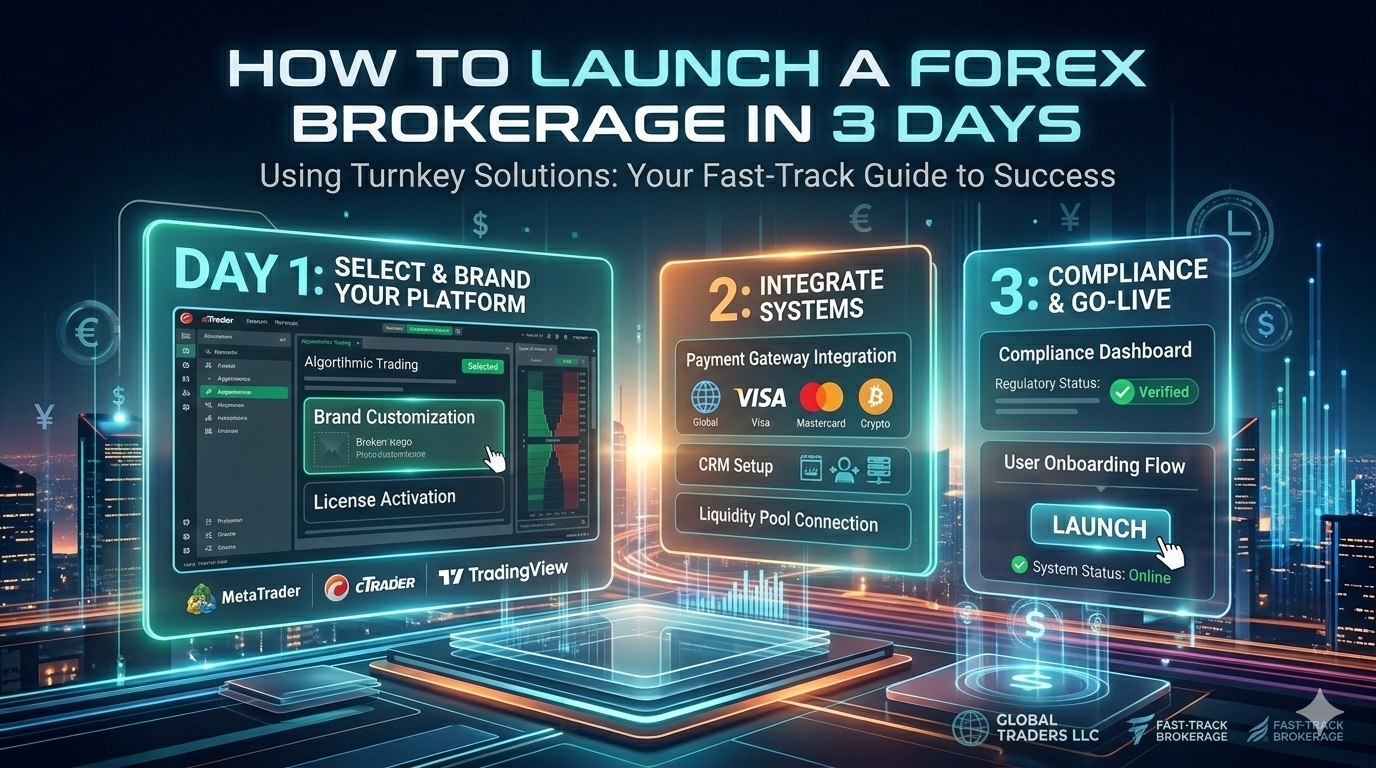
Day 1: Establishing the Framework
The first day of a rapid launch typically centers on aligning business structure with technology deployment. Compliance-related elements such as client agreements, AML/KYC policies, and risk disclosures are reviewed or implemented. Even when licensing is still underway, these components form the operational backbone of a legitimate brokerage.
Simultaneously, the trading platform is activated. Whether the broker chooses MT4, MT5, cTrader, or another platform, administrative access is granted and configuration begins. Instruments are selected, leverage settings defined, spreads adjusted, and account types structured.
Within hours, the brokerage environment begins to take recognizable shape.
Day 2: Liquidity and Risk Configuration
Once the platform framework is in place, attention shifts to the mechanics that drive execution quality. Liquidity providers are connected through bridging technology, enabling live pricing and order execution. Spread structures and routing logic are fine-tuned to align with the broker’s business model.
Risk management tools are configured alongside liquidity integration. Exposure monitoring, hedging rules, margin parameters, and stop-out levels are defined to protect the brokerage from unintended financial risk.
At the same time, CRM and back-office systems are finalized. Client registration flows, verification processes, reporting dashboards, and account management tools are activated, ensuring that onboarding and operations function smoothly.
Day 3: Payments, Testing, and Go-Live
A brokerage cannot operate commercially without reliable payment infrastructure. On the third day, deposit and withdrawal channels are integrated, whether through card processors, crypto gateways, or region-specific payment solutions.
Rigorous testing follows. Trade execution, latency, transaction flows, CRM workflows, and reporting accuracy are all validated. This phase is critical; overlooking it often results in operational issues that directly affect trader confidence.
Once stability and functionality are confirmed, the brokerage transitions into live mode.
Why Turnkey Solutions Enable Such Speed
The ability to launch within days rather than months stems from eliminating development and integration bottlenecks. Traditional builds require coordination between multiple vendors, each introducing compatibility risks and delays. Turnkey ecosystems remove much of this friction by offering pre-integrated components designed to work together.
The broker is not constructing infrastructure — they are configuring and activating it.
Balancing Speed With Long-Term Strategy
While rapid deployment is a powerful advantage, long-term success depends on more than technology. Marketing, client acquisition, support operations, and compliance oversight remain essential.
Infrastructure gets the brokerage live. Strategy keeps it sustainable.
Final Thoughts
Launching a Forex brokerage in three days is no longer an unrealistic claim when supported by a structured turnkey solution and proper preparation. The true benefit lies not just in speed, but in reducing technical complexity, minimizing costly mistakes, and entering the market with a professional-grade trading environment.
A fast launch shortens the path from concept to operation.
What defines success afterward is how well the business is managed.