

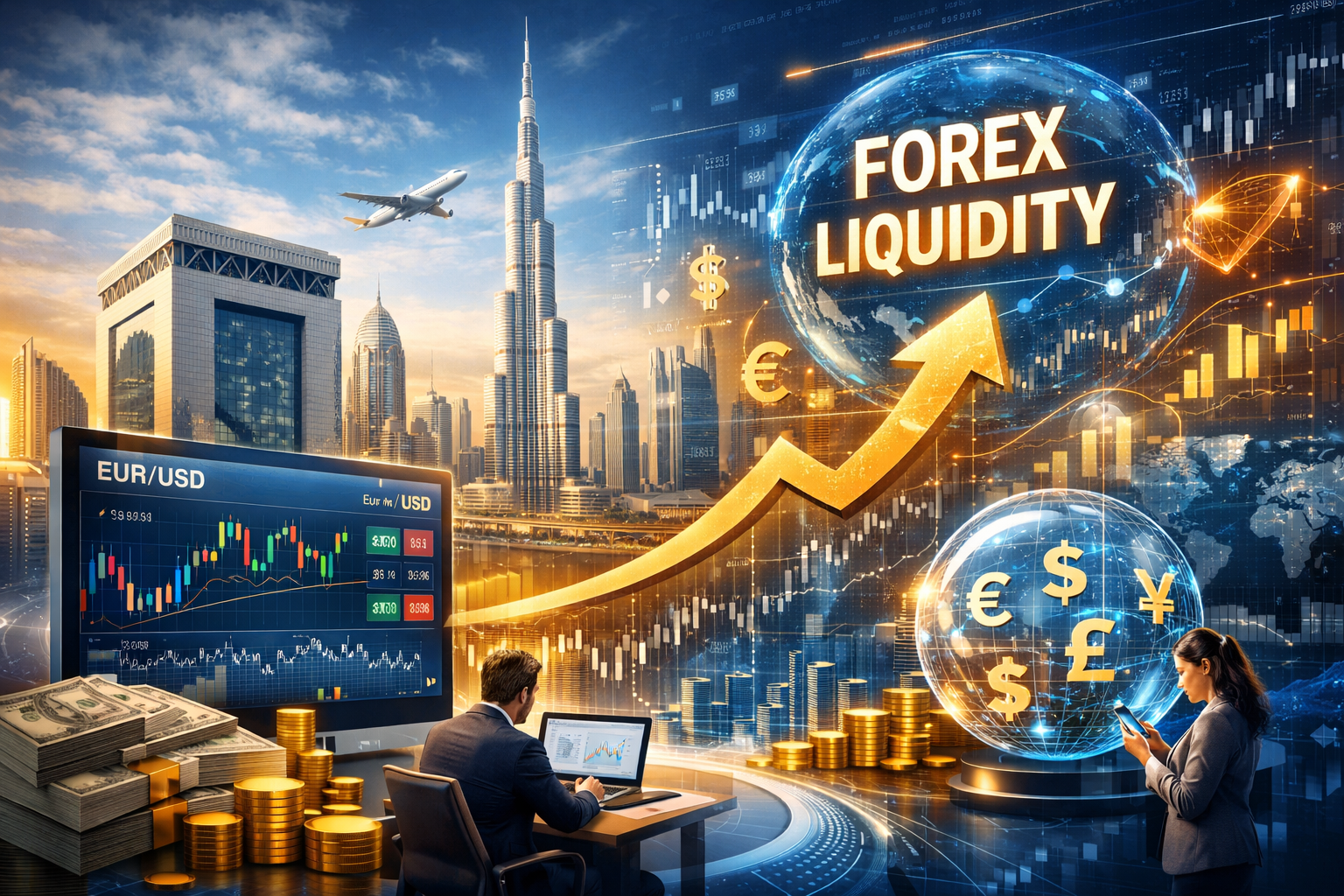
Over the last decade, Dubai has steadily transformed itself into one of the most influential financial hubs in the Middle East. What started as a regional trading center has now evolved into a global ecosystem where banks, fintech companies, forex brokers, and institutional investors operate side by side.
This transformation didn’t happen by accident. Dubai has invested heavily in financial infrastructure, regulatory frameworks, and technology-driven innovation. All of these factors together are strengthening the Dubai forex market infrastructure, making the region increasingly attractive for forex brokers and liquidity providers.
As global trading activity expands into the Middle East, Dubai’s financial ecosystem is playing a major role in shaping how forex liquidity is accessed, distributed, and managed.
Dubai’s Rise as a Financial Hub
Dubai’s financial growth has been driven by strategic planning and the creation of specialized financial zones. One of the most prominent examples is the Dubai International Financial Centre (DIFC), which has become home to hundreds of financial institutions, including banks, asset managers, fintech firms, and brokerage companies.
Another important financial district is the Abu Dhabi Global Market, which further strengthens the UAE’s overall financial ecosystem.
These financial zones offer internationally recognized regulatory frameworks, tax advantages, and advanced infrastructure. As a result, global firms are increasingly choosing the UAE as a base for their Middle East operations.
This steady expansion has helped build a strong Dubai forex market infrastructure, supporting liquidity networks that connect the region to global currency markets.
Why Forex Brokers Are Choosing Dubai
Forex brokers often look for locations that offer strong regulatory environments, reliable infrastructure, and access to international financial markets. Dubai checks all three boxes.
First, the regulatory framework within DIFC is managed by the Dubai Financial Services Authority (DFSA). The authority enforces strict compliance standards, which helps build trust among investors and institutional traders.
Second, Dubai offers advanced digital and technological infrastructure that supports high-speed trading environments.
Third, its geographic location acts as a bridge between Europe, Asia, and Africa. This allows brokers to serve clients across multiple time zones.
All these elements strengthen the Dubai forex market infrastructure, creating a stable environment where liquidity providers and brokers can operate efficiently.
The Role of Technology in Forex Liquidity
Modern forex trading depends heavily on technology. Liquidity providers stream pricing data from global banks and financial institutions, and brokers must process this information instantly.
Dubai has invested heavily in technology-driven financial services, particularly through fintech initiatives and innovation hubs located within DIFC.
These developments allow brokers to access advanced tools such as:
- Liquidity aggregation systems
- Low-latency trading networks
- Cloud-based trading platforms
- AI-powered risk management tools
Such technologies are becoming essential components of the Dubai forex market infrastructure, allowing brokers to deliver faster execution and competitive spreads.
Increasing Institutional Participation
Another reason Dubai’s forex ecosystem is gaining global attention is the growing presence of institutional investors.
Hedge funds, proprietary trading firms, and asset management companies are increasingly setting up operations in the UAE. Institutional traders usually require deep liquidity pools and reliable trading infrastructure.
As demand for institutional trading grows, liquidity providers are expanding their networks in the region.
This trend strengthens the Dubai forex market infrastructure, as brokers gain access to more diverse liquidity sources and improved market depth.
Liquidity Providers and Market Connectivity
Liquidity providers play a central role in the forex ecosystem. They supply the pricing and market depth that brokers need to execute trades efficiently.
In Dubai, the presence of international financial institutions has made it easier for brokers to connect with multiple liquidity sources.
These connections often involve sophisticated trading infrastructure that includes liquidity aggregation engines, FIX API connectivity, and smart order routing systems.
Many brokers rely on advanced infrastructure solutions similar to what a liquidity provider for forex brokers offers to access aggregated liquidity pools and maintain stable trading conditions.
Such systems help strengthen the Dubai forex market infrastructure by ensuring brokers can offer competitive pricing and reliable trade execution.
Regulatory Stability and Market Confidence
A strong regulatory framework is essential for any financial market. Investors and institutions need confidence that the system is transparent and well supervised.
Dubai’s financial zones are designed to follow international regulatory standards, which makes them attractive to global market participants.
The Dubai Financial Services Authority ensures that firms operating within DIFC follow strict compliance rules related to risk management, reporting, and client protection.
This regulatory stability contributes significantly to the growth of the Dubai forex market infrastructure, encouraging more firms to establish operations in the region.
The Growing Role of Fintech in Forex Markets
Fintech companies are also shaping the future of forex liquidity in Dubai. Startups focusing on trading technology, payment systems, and digital assets are introducing new tools that improve efficiency in financial markets.
Some fintech platforms are developing AI-driven liquidity management systems, while others focus on blockchain-based settlement solutions.
These innovations may soon become integrated into the broader Dubai forex market infrastructure, making trading processes faster and more transparent.
As fintech adoption increases, Dubai’s role as a global financial innovation hub will likely grow even further.
Dubai’s Strategic Position in Global Trading
One of Dubai’s biggest advantages is its strategic geographic location.
The city sits between major financial centers like London, Singapore, and Hong Kong. This positioning allows trading activity to continue smoothly as global markets transition across time zones.
For forex brokers, this creates an opportunity to maintain continuous trading operations and serve clients across multiple regions.
As global trading volumes increase, this connectivity further strengthens the Dubai forex market infrastructure and its importance in the international forex market.
What the Future Looks Like
Looking ahead, Dubai’s financial ecosystem is expected to expand even further. Government initiatives supporting digital transformation, fintech innovation, and global investment will likely attract more financial institutions.
As more banks, liquidity providers, and trading firms establish operations in the region, liquidity networks will continue to grow.
This ongoing development will enhance the Dubai forex market infrastructure, enabling brokers to access deeper liquidity pools and deliver better trading conditions to clients.
Final Thoughts
Dubai has successfully positioned itself as a global financial gateway connecting markets across continents. Through strong regulation, advanced technology, and a supportive business environment, the city has built a powerful ecosystem for financial services.
For forex brokers and liquidity providers, this ecosystem creates new opportunities for growth and innovation.
As institutional participation increases and trading technology continues evolving, the Dubai forex market infrastructure will play an even greater role in shaping the future of forex liquidity in the Middle East and beyond.