

Over the past few years, the UAE has quietly become one of the most active trading hubs in the Middle East. Dubai in particular has attracted forex brokers, fintech startups, and professional trading firms from around the world. With this growth, trading technology in the region is evolving quickly.
One trend that’s impossible to ignore now is the rise of algorithmic trading and high-frequency trading. These trading strategies rely heavily on automation, speed, and real-time data. Unlike manual trading, algorithms make decisions in milliseconds. That means the entire trading environment must be fast, stable, and supported by deep market liquidity.
This is exactly where a forex liquidity provider UAE becomes important. Without strong liquidity behind the scenes, automated trading strategies simply cannot operate efficiently.
Let’s look at how liquidity providers make algorithmic and high-frequency trading possible in the UAE’s growing forex ecosystem.
The Growing Demand for Algorithmic Trading
Not long ago, most forex trading in the region was done manually. Traders would analyze charts, place orders themselves, and manage positions throughout the day.
Things have changed.
Today, many traders rely on automated systems that execute trades based on predefined conditions. These systems analyze price movements, technical indicators, and market patterns faster than a human ever could.
Algorithmic trading is becoming popular in the UAE for several reasons:
- Better trading technology available to brokers
- Increased participation from institutional traders
- Growing fintech infrastructure in Dubai
- Access to global liquidity pools
But here’s the thing — automated strategies depend entirely on execution quality. If trades cannot be executed instantly, the strategy loses its edge.
That’s why brokers operating in the region increasingly rely on a reliable forex liquidity provider UAE to support algorithmic trading clients.
Why High-Frequency Trading Needs Deep Liquidity
High-frequency trading, often called HFT, is even more demanding.
These strategies place thousands of trades in very short timeframes. The goal is usually to capture tiny price differences that exist for only a few seconds or even milliseconds.
Without deep liquidity, those trades would never get filled.
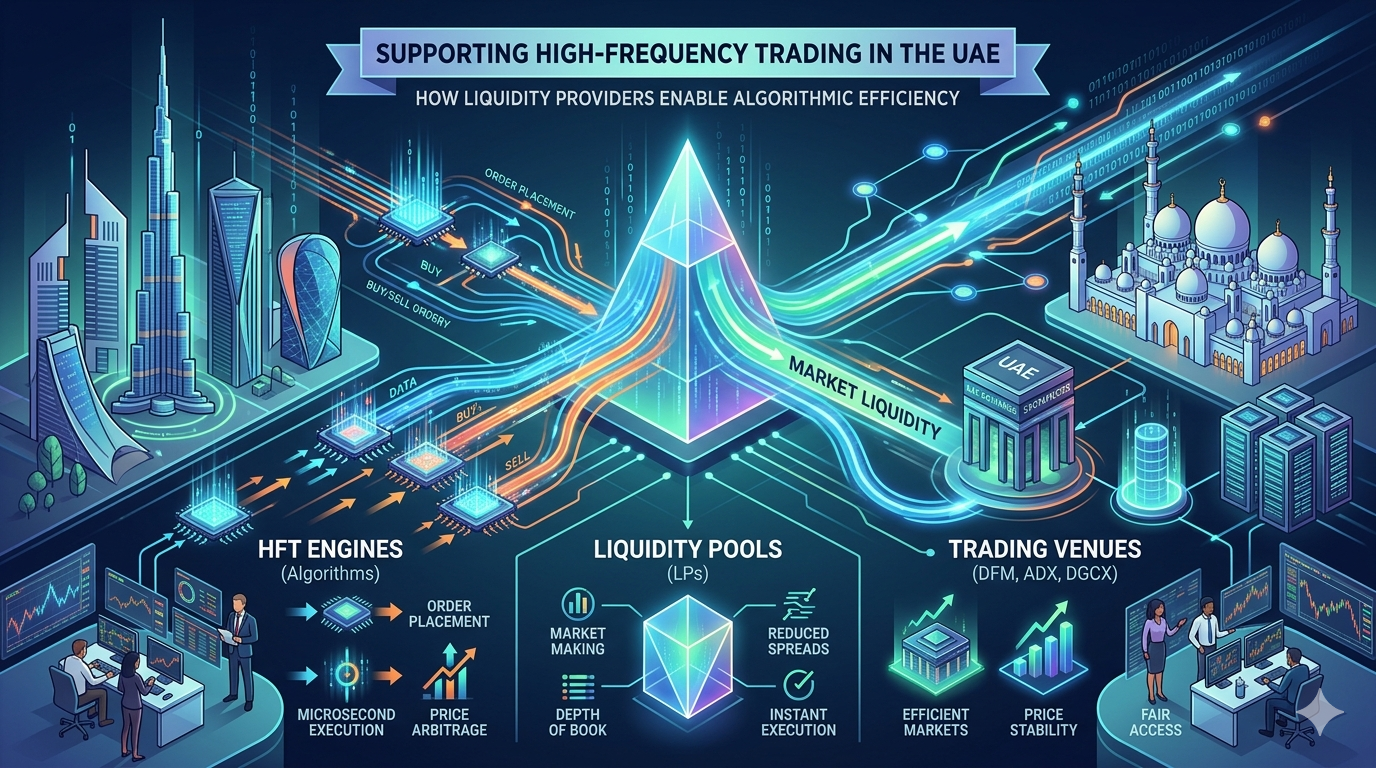
Liquidity providers solve this problem by connecting brokers to large pools of institutional liquidity. These pools typically include:
- Global banks
- Non-bank market makers
- Institutional trading firms
- Electronic communication networks (ECNs)
Instead of relying on a single pricing source, brokers receive multiple price feeds. These feeds are aggregated and displayed to traders in real time.
A strong forex liquidity provider UAE ensures that large numbers of trades can be executed without causing major price movements. That stability is critical for high-frequency strategies.
Speed Matters More Than Ever
When people talk about algorithmic trading, they often focus on the strategies themselves. But the real challenge is infrastructure.
Speed is everything.
If an algorithm identifies a trading opportunity but the order takes too long to reach the market, that opportunity disappears.
Liquidity providers help solve this by offering ultra-fast connections between trading platforms and liquidity pools. Many providers operate high-performance servers located near major financial data centers.
This reduces latency — the tiny delay between placing a trade and executing it.
For brokers in the UAE, working with a dependable forex liquidity provider UAE ensures that automated trading systems can execute trades with minimal delay.
And for algorithmic traders, those milliseconds make a big difference.
Consistent Pricing and Market Stability
Another important factor for automated trading is price consistency.
Algorithms rely on accurate market data. If spreads suddenly widen or pricing becomes unstable, trading systems can produce incorrect signals.
Liquidity providers reduce this risk by streaming constant bid and ask prices from multiple institutions. This creates a more stable trading environment.
Instead of sudden price gaps, traders see smoother market movements and reliable spreads.
In simple terms, a well-connected forex liquidity provider UAE acts like the backbone of the trading environment. It keeps the market flowing smoothly so automated systems can function the way they’re supposed to.
Institutional Traders Are Entering the UAE Market
Another reason liquidity providers are becoming more important is the rise of institutional trading activity in the region.
Dubai has become an attractive destination for hedge funds, proprietary trading firms, and fintech companies. Many of these organizations rely heavily on automated trading systems.
Institutional traders typically expect:
- Tight spreads
- Deep liquidity pools
- Fast order execution
- Reliable trading infrastructure
Brokers need strong backend systems to meet those expectations.
That’s why many platforms integrate professional liquidity solutions that connect directly to institutional markets. These integrations allow brokers to offer trading conditions similar to global financial centers.
For example, brokers often connect their trading infrastructure with a liquidity provider for forex brokers to access deeper market liquidity and stable execution systems.
This type of infrastructure is becoming increasingly common as the UAE trading ecosystem grows.
Risk Management in Automated Trading
Automated trading generates a large number of transactions very quickly. While this increases market activity, it can also create risk for brokers if trades are not managed properly.
Liquidity providers help brokers control this risk.
One common method is hedging. When traders open large positions, brokers can offset those positions through external liquidity sources. This reduces exposure to sudden market moves.
Liquidity systems also help with smart order routing. Orders can be directed automatically to the best available pricing sources.
In practice, this means trades are executed more efficiently while brokers maintain balanced market exposure.
A strong forex liquidity provider UAE plays a key role in maintaining that balance.
Technology Behind Modern Liquidity Infrastructure
Behind every trading platform is a complex network of technology that connects brokers, liquidity providers, and financial markets.
Some of the technologies commonly used include:
- Liquidity aggregation systems
- Bridge solutions connecting trading platforms
- FIX API connectivity
- High-performance matching engines
These systems ensure that trading platforms receive real-time pricing and execute trades efficiently.
For brokers targeting professional traders in the UAE, choosing the right forex liquidity provider UAE is as much a technology decision as it is a financial one.
Better infrastructure usually translates into better trading conditions.
The UAE Is Becoming a Global Trading Hub
The UAE’s role in global trading continues to expand. With strong financial regulation, growing fintech investment, and international connectivity, the region is attracting traders from Europe, Asia, and the Middle East.
As the ecosystem matures, trading strategies are also becoming more advanced.
Algorithmic trading, machine learning models, and automated portfolio systems are already shaping how markets operate.
All of these innovations rely on the same thing — stable liquidity.
That’s why the importance of a strong forex liquidity provider UAE will only grow in the coming years.
Final Thoughts
Algorithmic and high-frequency trading are no longer limited to major financial centers like London or New York. The UAE is quickly becoming part of that global trading network.
But automated trading systems need more than just smart algorithms. They require fast execution, reliable pricing, and deep liquidity pools.
This is where liquidity providers play a critical role.
A dependable forex liquidity provider UAE ensures that brokers can deliver stable market conditions, support high-speed trading strategies, and attract sophisticated traders.
As trading technology continues to evolve, brokers that invest in strong liquidity infrastructure will be better positioned to compete in the UAE’s rapidly growing forex market.