

Getting traffic to your brokerage website is one thing. Turning that traffic into active, depositing traders is something entirely different.
Many forex brokers invest heavily in advertising, SEO, and promotional campaigns with the expectation that visibility will automatically translate into growth. Yet despite strong traffic numbers, conversion rates often remain underwhelming. Leads hesitate, registrations stall, and client acquisition costs continue to rise.
The problem is rarely a lack of leads.
More often, it is the absence of a structured funnel that guides potential traders through the decision-making process. Without that structure, prospects arrive, browse, and leave without progressing toward meaningful engagement.
In an industry where trust and confidence are critical, this gap can significantly impact profitability.
What Is a Forex Broker Digital Marketing Funnel?
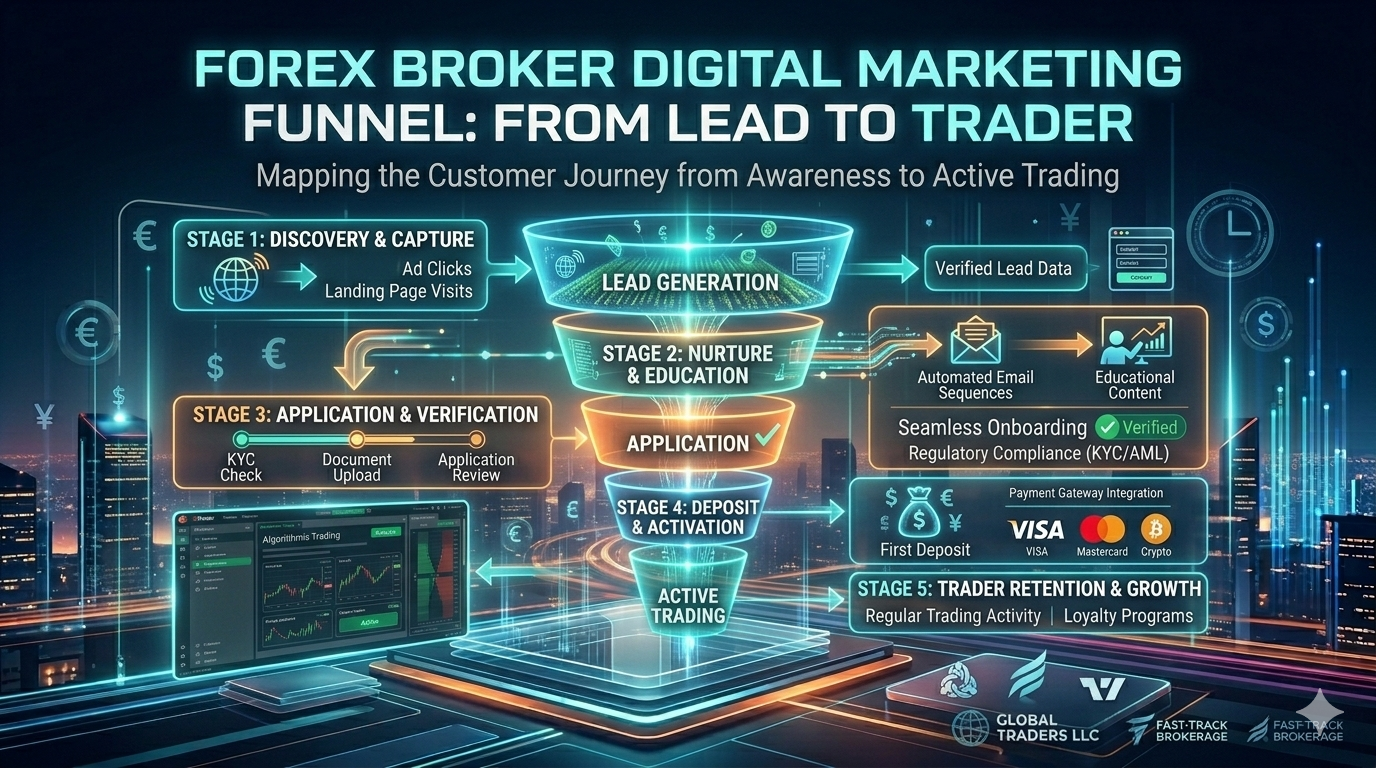
A digital marketing funnel represents the journey a potential client follows from their first interaction with your brokerage to becoming an active trader.
Unlike impulse-driven industries, forex operates in a space where decisions involve financial risk, credibility assessment, and careful comparison. Traders evaluate brokers based on reputation, platform reliability, trading conditions, and fund security before committing capital. Rarely is this decision immediate.
A well-designed funnel helps brokers manage this naturally cautious process. Instead of leaving conversions to chance, it creates a logical progression that nurtures awareness, builds trust, reduces hesitation, and supports client activation.
Stage 1: Awareness – Establishing Visibility
Every client relationship begins with discovery.
At the awareness stage, traders are not necessarily searching for your brokerage specifically. They are exploring trading strategies, learning technical analysis, comparing platforms, or following market news. This is where brokers position their brand through educational content, search engine visibility, paid advertising, and social media presence.
The objective here is not immediate conversion. It is about capturing attention and creating curiosity. Traders who first encounter your brokerage through valuable, relevant content often enter the funnel with a more positive perception.
Stage 2: Interest – Turning Visitors into Leads
Once visitors arrive on your website, the focus shifts from visibility to engagement.
Traffic alone holds little business value if users leave without interacting. At this stage, brokers aim to create meaningful touchpoints that encourage prospects to stay connected. Demo account registrations, educational resources, webinars, market reports, and newsletters provide value while opening channels for continued communication.
This phase recognizes a key reality of forex marketing: most traders require multiple interactions before opening an account.
Lead capture ensures the relationship continues beyond a single visit.
Stage 3: Consideration – Building Trust and Confidence
This is where most forex decisions are truly formed.
Leads begin evaluating the brokerage more critically, comparing trading conditions, assessing credibility, and examining risk factors. Questions surrounding fund safety, spreads, execution quality, platform stability, and withdrawal reliability become central to the decision process.
Successful brokers focus on reducing uncertainty rather than applying pressure. Transparency, clear communication, regulatory visibility, client testimonials, and accessible support channels all contribute to strengthening confidence.
Trust becomes the primary conversion driver at this stage.
Stage 4: Conversion – From Lead to Registered Client
Even highly interested prospects can disengage if onboarding introduces friction.
Complicated registration processes, unclear verification requirements, lengthy approval times, or technical obstacles often discourage potential clients. A seamless onboarding experience, on the other hand, reassures traders and maintains momentum.
When account opening feels intuitive, secure, and straightforward, conversion rates naturally improve. The smoother the transition from lead to registered client, the lower the acquisition waste.
Stage 5: Activation – From Client to Trader
Opening an account does not automatically create an active trader.
A significant portion of newly registered clients never proceed to deposit funds or place trades. Activation strategies exist to bridge this gap by guiding clients toward their first meaningful action. Welcome communications, platform tutorials, educational onboarding, and personalized assistance help new clients build confidence.
The first deposit is a pivotal milestone. It marks the transition from passive registration to genuine participation.
Stage 6: Retention – Sustaining Engagement
Long-term brokerage success depends heavily on retention.
Consistent trader engagement through ongoing education, market insights, personalized communication, loyalty initiatives, and reliable support helps maintain trading activity. In forex, profitability is rarely defined by the first deposit alone. It is shaped by the duration and consistency of client participation.
Retention strategies stabilize revenue while improving lifetime value.
Why Many Broker Funnels Fail
Even with strong marketing budgets, funnels often break at critical stages.
Traffic may be directed to poorly optimized landing pages, trust signals may be weak, onboarding may feel overly complex, or follow-up communication may be inconsistent. In many cases, brokers focus heavily on acquisition while underinvesting in nurturing and activation.
Without alignment between marketing, user experience, and conversion design, growth becomes unpredictable.
Final Thoughts
In the forex industry, the journey from lead to trader is shaped by caution, evaluation, and trust-building. Prospects rarely move instantly from awareness to deposit. They research, compare alternatives, and assess risk before making financial commitments.
A structured Forex Broker Digital Marketing Funnel provides the continuity and clarity required to guide this process effectively. It transforms marketing from isolated campaigns into a cohesive system that attracts, nurtures, converts, and retains clients.
Because brokerage marketing success is not defined by how many visitors click.
It is defined by how many traders stay.