

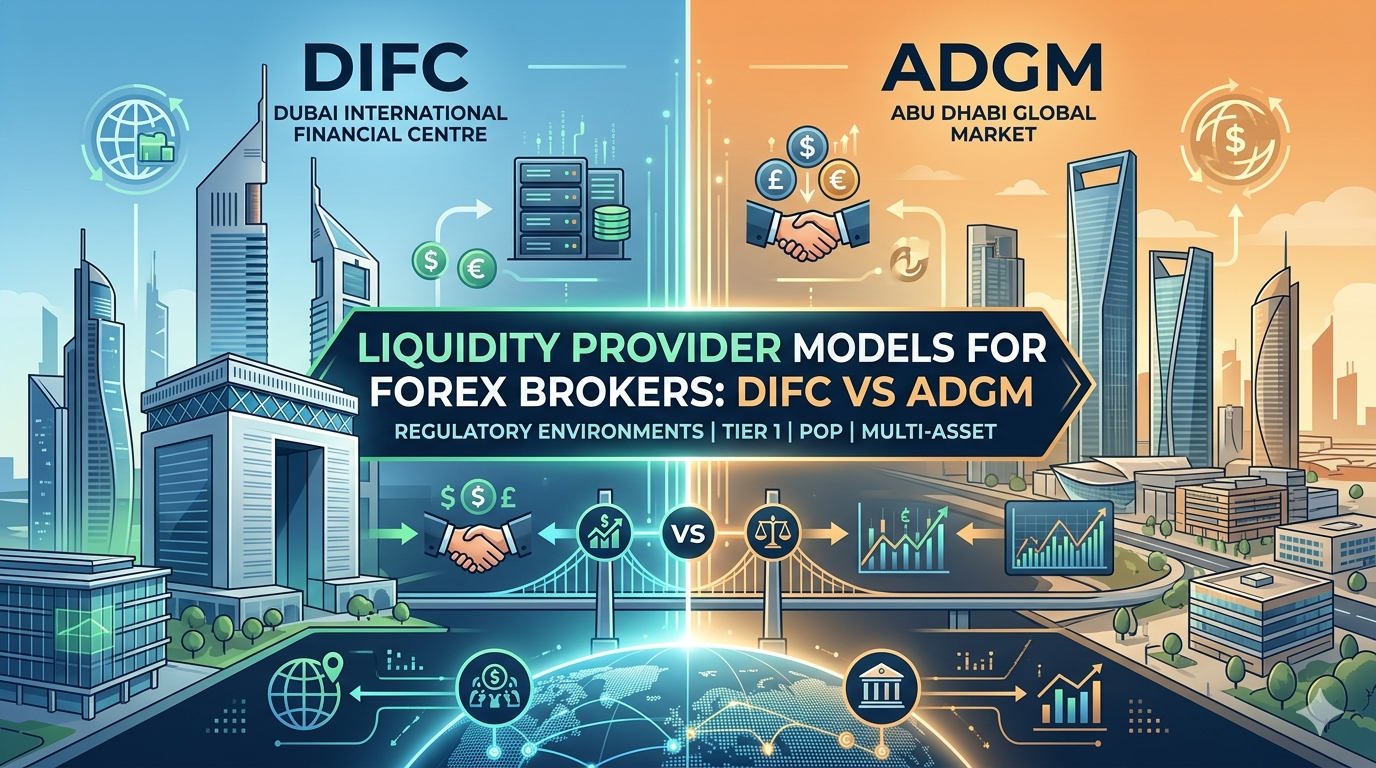
The United Arab Emirates has become one of the most attractive regions for launching a forex brokerage. Two financial hubs dominate this ecosystem — the Dubai International Financial Centre (DIFC) and the Abu Dhabi Global Market (ADGM). Both jurisdictions offer strong regulatory frameworks, international connectivity, and infrastructure designed for financial institutions.
However, when forex brokers start setting up operations in these financial zones, one critical question appears early in the process: which liquidity model works best?
The choice of a liquidity provider DIFC or a liquidity provider ADGM structure can influence execution quality, compliance requirements, and even the trading experience clients receive.
Let’s explore how liquidity provider models differ between these two financial centers and what forex brokers should consider before choosing one.
Understanding Liquidity Providers in Forex
Before diving into the DIFC vs ADGM comparison, it helps to briefly understand what liquidity providers actually do.
A liquidity provider connects brokers to the broader forex market by streaming buy and sell prices from large institutions. These institutions may include global banks, market makers, and electronic trading networks.
Instead of creating their own prices, brokers rely on these providers to supply:
- Real-time bid and ask pricing
- Deep liquidity pools
- Fast trade execution
- Market stability during volatility
Without strong liquidity infrastructure, brokers may struggle with wide spreads, slippage, or slow execution speeds.
That’s why choosing the right liquidity provider DIFC or liquidity provider ADGM arrangement is a strategic decision for forex businesses entering the UAE market.
The DIFC Trading Ecosystem
The Dubai International Financial Centre has long been the region’s main financial hub. Many international banks, asset managers, and fintech companies operate from DIFC.
For forex brokers, DIFC offers several advantages:
- Access to global financial institutions
- A mature fintech ecosystem
- Strong legal framework based on English common law
- Direct connectivity to global trading infrastructure
Because of its established financial network, brokers operating in DIFC often prefer institutional liquidity models.
In these setups, a liquidity provider DIFC typically aggregates pricing from multiple Tier-1 banks and institutional trading firms. This allows brokers to offer tighter spreads and better execution to professional traders.
Many institutional trading firms and hedge funds working out of Dubai also expect this level of liquidity infrastructure.
The ADGM Trading Environment
The Abu Dhabi Global Market has grown rapidly over the past few years. While DIFC has a longer history, ADGM has been positioning itself as a modern financial hub focused on fintech innovation and digital finance.
ADGM’s regulatory framework is also based on English common law, and the jurisdiction has attracted numerous fintech startups and investment firms.
For forex brokers, the liquidity model in ADGM can be slightly different.
Some brokers working in ADGM rely on hybrid liquidity models, combining external liquidity providers with internal risk management strategies.
This allows brokers to manage trading exposure more flexibly while still offering competitive trading conditions.
In this setup, a liquidity provider ADGM often acts as part of a broader liquidity ecosystem rather than the sole source of market execution.
Key Differences Between Liquidity Models
While both DIFC and ADGM support institutional trading environments, there are a few practical differences brokers often notice when choosing between them.
1. Institutional Network Access
DIFC generally offers deeper connections to global banking institutions. Many large financial institutions already operate there.
Because of this, a liquidity provider DIFC setup often involves direct institutional market access.
ADGM, while growing quickly, is still expanding its institutional network. Liquidity arrangements there may involve more hybrid or aggregated liquidity sources.
2. Brokerage Infrastructure
Brokers operating in DIFC tend to build more institutional-grade trading environments. This means high-speed servers, advanced order routing systems, and liquidity aggregation technology.
ADGM brokers may still use similar infrastructure but often experiment more with fintech-based trading solutions.
Both environments can support professional trading operations, but DIFC has traditionally attracted larger financial institutions.
3. Regulatory Considerations
Regulation is another factor when choosing liquidity models.
DIFC is regulated by the Dubai Financial Services Authority (DFSA), which places strong emphasis on transparency and best execution practices.
Brokers working with a liquidity provider DIFC must demonstrate clear order routing practices and reliable pricing sources.
ADGM operates under the Financial Services Regulatory Authority (FSRA). While similar in many ways, ADGM’s regulatory environment has been particularly welcoming to fintech innovation.
This means brokers working with a liquidity provider ADGM may explore newer trading technologies and liquidity integration methods.
Technology Integration With Liquidity Providers
Regardless of whether a broker operates in DIFC or ADGM, technology plays a central role in connecting liquidity providers to trading platforms.
Modern forex brokers typically use:
- Liquidity aggregation engines
- Bridge solutions connecting platforms to liquidity pools
- FIX API connectivity
- Real-time market data feeds
These technologies allow brokers to route orders efficiently and provide traders with consistent pricing.
Many brokers rely on professional infrastructure solutions similar to those offered by a liquidity provider for forex brokers that connect trading platforms to deep institutional liquidity pools.
This type of integration ensures brokers can maintain competitive spreads and reliable execution regardless of their jurisdiction.
Choosing the Right Liquidity Model
For brokers deciding between DIFC and ADGM, the best liquidity model usually depends on the type of trading environment they want to create.
Brokers targeting institutional traders and hedge funds often prefer the strong financial network available in DIFC.
On the other hand, brokers focused on fintech innovation or emerging trading technologies may find ADGM’s environment appealing.
In both cases, the role of liquidity providers remains critical.
A reliable liquidity provider DIFC or liquidity provider ADGM ensures that brokers can deliver stable pricing, fast execution, and scalable trading infrastructure.
Without this foundation, even the most advanced trading platforms struggle to compete.
Final Thoughts
The UAE continues to strengthen its position as a global financial center, and both DIFC and ADGM are playing important roles in that growth.
While the two jurisdictions share many similarities, their liquidity ecosystems can differ slightly depending on the broker’s business model and trading strategy.
For forex brokers entering the region, choosing the right liquidity provider DIFC or liquidity provider ADGM setup is more than a technical decision. It affects trade execution quality, regulatory compliance, and the overall trading experience offered to clients.
As the UAE trading industry continues evolving, brokers that build strong liquidity partnerships will be better positioned to compete in the increasingly sophisticated forex market.